How a Wooden Name Puzzle Is Made
The things that separate name puzzles are whether each piece was cut from the recess it sits in, whether the edges were sanded after cutting, how thick the paint is, and how thick the board is. Those four decide fit and feel.
Search for a personalized name puzzle and the listings look alike, photographed at the same angle on the same pale background. The difference is in four construction decisions that no listing photo shows.
Whether the piece was cut from its own recess
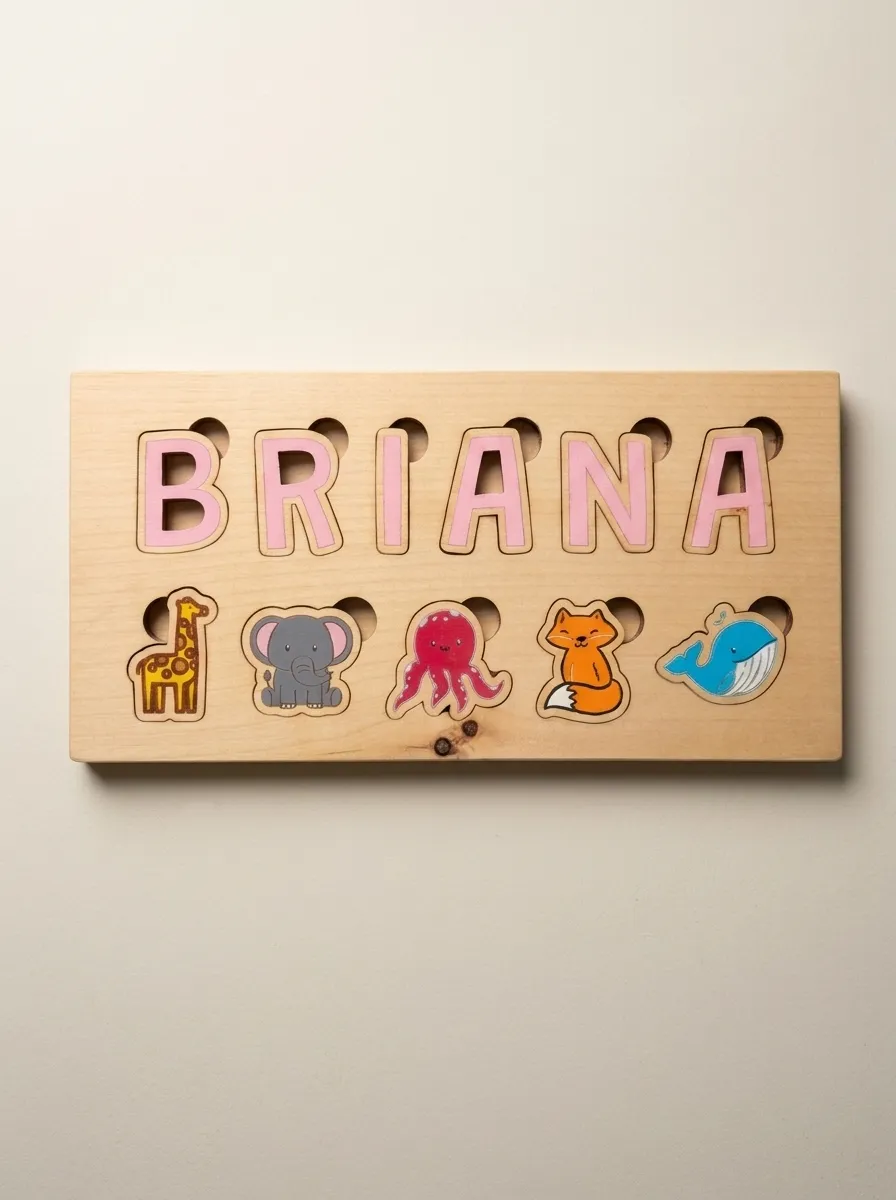
This is the one that decides fit, and it is invisible in photographs. When a letter is cut out of the board it sits in, the piece and the recess share an edge and match exactly. When the board and the pieces are cut separately to nominal sizes, they match approximately, and approximately means some letters drop through loose while others bind and have to be worked out.
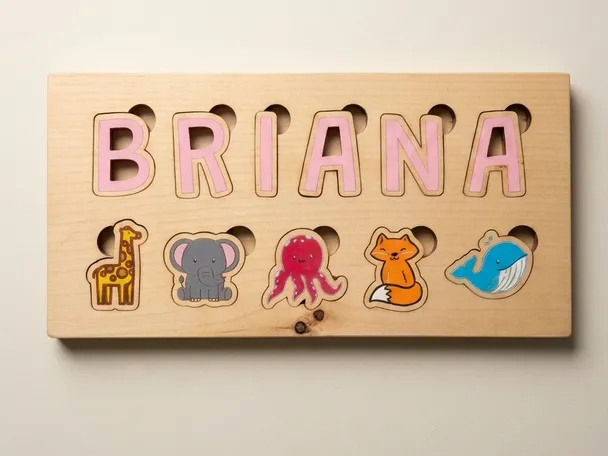
A binding piece is worse than a loose one. A child who has to fight a piece stops using it, and a stuck letter can end play.
Whether the edges were sanded after cutting
On a laser-cut puzzle the outline of each piece looks drawn on: the beam leaves a fine char line along every edge. Left alone, that line marks fingers and feels dusty. Sanded, it stays as a crisp outline and the edge goes smooth.
Sanding is slow, per-piece hand work with no photographic evidence, which makes it the first step to disappear at volume. It matters more on a puzzle than on a wall sign: a wall sign is looked at, and a puzzle is picked up, dropped, and mouthed at the edges by someone who will find a rough spot faster than any adult would.
How thick the paint is
A thin coat lets the grain read through the color, so a painted letter still looks like painted wood. A heavy, glossy coat covers the grain completely, and the result reads as plastic in the hand even though it is not. Neither is wrong, but they are different objects.
Thick paint also fills in detail. On a short name it makes little difference; on letterforms with tight interior corners it rounds them off, which is where a name starts looking approximately right rather than right.
How thick the board is
Board thickness sets how much of a piece a hand has to hold on to, and how the puzzle survives being stood on. A thin board flexes, and a flexing board eventually stops holding its pieces at the same depth. Around an inch is enough that pieces have a real edge to grip and the board stays flat; much thinner and both go.
Thickness also decides whether the puzzle can sit on a shelf as a keepsake after the play years. That is worth something on a personalized piece in a way it would not be on a generic one. Our guide to wood types covers how species choice plays into the same question.
The questions worth asking any seller
- Are the pieces cut from the board they sit in? The fit answer. Ask it first.
- Is every piece sanded after cutting, and test-fitted before it ships? Two separate steps and both get skipped at volume.
- What coating is on it, and is it tested to a toy-safety standard? A specific answer is a good sign. A listing that answers "child safe materials" and nothing more has told you nothing.
- What happens if a piece is lost? On a personalized puzzle there is no stock replacement, so the answer varies enormously.
- Who cut it, and where? Not a quality guarantee on its own. It tells you who you are dealing with when something is wrong, which is the part that matters after the sale.
What we can and cannot document about ours
Ours is solid wood, roughly an inch thick, with every letter and animal cut from the board it seats into. Each piece is hand-painted in a thin matte coat that leaves the grain visible, then the board face, its edges, and every individual piece are sanded by hand and test-fitted before it ships. It is cut, painted, and packed in our Denver studio, and we send a free proof within 24 hours of an order and start cutting once you approve it.
What we are not going to do is tell you the coating is certified to a toy-safety standard until we can point at the document that says so. We are confirming that. Until we have that document, follow the product page: this is a small-parts toy suited to a child old enough for lift-out pieces under supervision, generally three and up, and pieces should be kept away from younger siblings still at the mouthing stage.
Name Puzzle Construction Questions
Why does a handmade name puzzle cost $44?
Mostly labor. A template puzzle drops the name into a fixed layout. A handmade one is laid out for the specific name, cut, painted, sanded, and test-fitted by a person.
Is the paint on a name puzzle safe for a child who mouths toys?
Ask the seller for the specific coating and any toy-safety standard it is tested to, and treat a listing that will not answer as an answer. We can tell you ours is a thin matte paint applied by hand and that every piece is sanded after painting; we are confirming the coating documentation and will state it here rather than imply it. In the meantime, this is a puzzle for a child old enough for lift-out pieces under supervision, generally three and up.
Does laser cutting leave a burnt smell or residue?
A laser leaves a fine char line at the cut edge, which is why the outline on a laser-cut piece looks drawn on. A faint smell can linger on new work and fades. Check whether the maker sands after cutting: an unsanded char edge marks fingers, and a sanded one does not.
What does "made in USA" actually tell me about a name puzzle?
Less than it sounds like on its own, since it covers everything from a one-person studio to a large factory. The useful follow-up is where the piece is cut and finished, and by whom. Ours are cut, painted, and packed in our Denver studio, which is worth knowing mainly because it is who you are talking to if something is wrong.
Want one made this way, with their name on it?
Every wooden name puzzle is laid out for the specific name rather than dropped into a fixed template, so the board widens with a longer name instead of the letters shrinking to fit. If you are still deciding how a child should lift the pieces, the styles comparison covers pegs, knobs, finger holes, and interlocking. For a batch, the wholesale wooden personalized name puzzles page answers them, where every board is cut and hand-painted individually at any count.