Wooden Name Puzzle by Age
A wooden name puzzle is handling and sensory play under three, piece-into-recess play around three, and letter-focused spelling play from four on. After that it mostly becomes a keepsake. There's no age where it teaches reading on its own.
A name puzzle usually gets bought before the child is old enough to use it the way the box photo suggests, which makes "what age is this for" a harder question than it sounds.
What age is a name puzzle for?
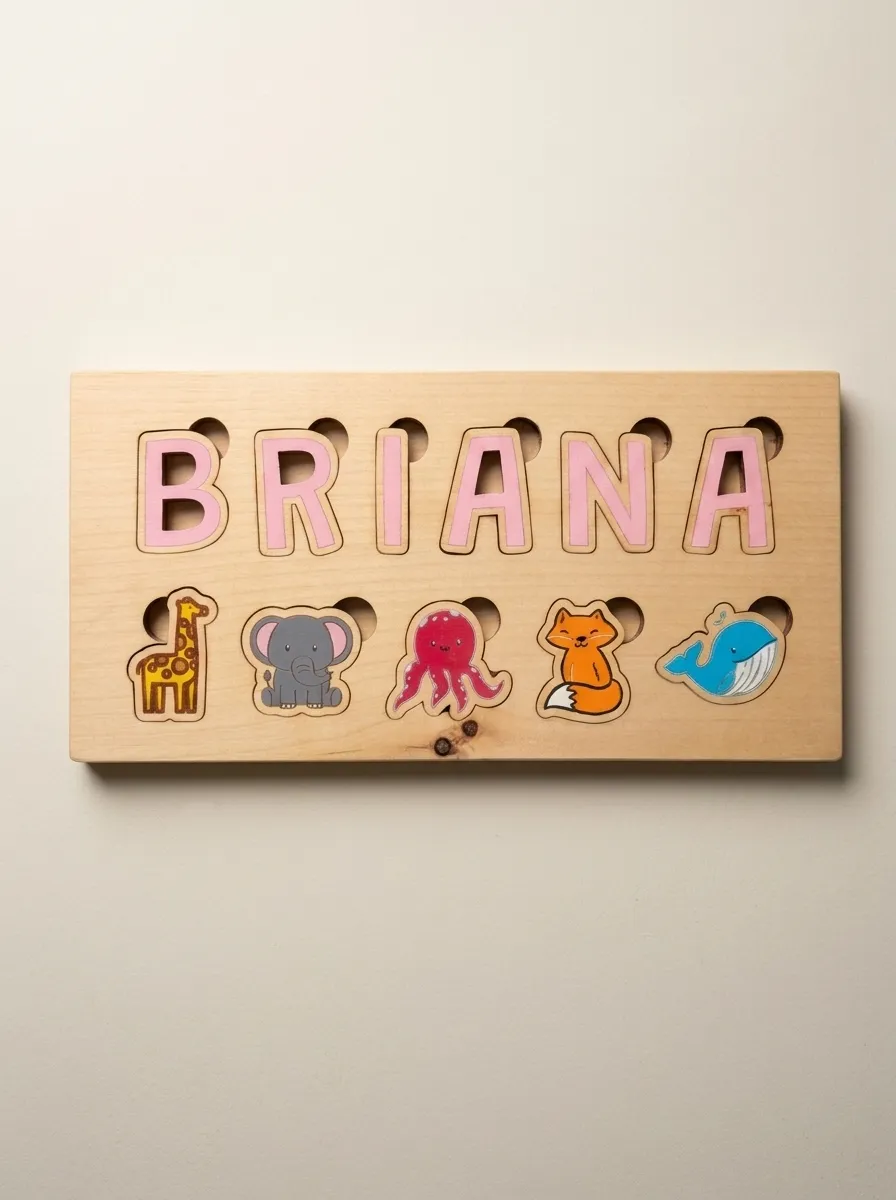
The range is three and up for independent, unsupervised play. That number comes from safety: the letters and any animal pieces lift completely free of the board, and loose pieces that size are a choking hazard for a child who still mouths toys. Younger than three, this is supervised play, not toy-bin play.
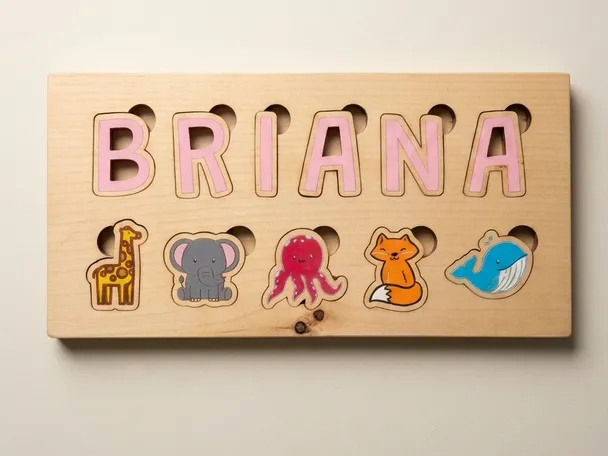
That said, "for age three" and "useful starting at birth" aren't in conflict. Bought for a baby shower, it works as nursery decor first. The active play comes later.
What can a child do with a name puzzle at each age?
Under three it's handling and exploring. Around three the pieces start fitting their recesses. From four on, the letters become the point, and after that it's a keepsake more than a toy. Not intended for children under 3 without adult supervision, since the letters and animal pieces lift completely free of the board.
| Age band | Type of play |
|---|---|
| Under 3, with an adult close by | Mostly handling: lifting a piece out, turning it over, dropping it, occasionally trying to fit it somewhere that isn't the right recess. Animal pieces get more attention than letters. |
| Around 3 | Piece-into-recess starts working, usually with the animals first. A child starts recognizing the shape of their whole name as one unit before naming a single letter inside it. |
| 4 and up | The letters become the point: dumping pieces out, rebuilding the name from scratch, and naming letters as they go back in. Survives being handed to a sibling or friend. |
| After that | Mostly a keepsake, not a toy. Once active play winds down, it can stay on a shelf. |
Ways to use it beyond just fitting pieces
Once a child can reliably place every piece, the puzzle keeps earning its spot in the toy bin through small variations rather than staying static:
- The missing-letter game: pull one letter out while a child isn't looking, then ask which one is gone. Works well as a five-minute activity before nap or bedtime.
- Scramble and rebuild: dump every letter out of order and let the child put the name back together unassisted. A natural next step once basic piece-fitting is easy.
- Letter-to-word: name a word that starts with each letter as it goes back into its recess. Turns the puzzle into a light vocabulary game without any extra materials.
- Hand it off: once a child is old enough, letting an older sibling or a friend run the whole puzzle independently is its own kind of play, less about the letters and more about ownership and pride in "their" piece.
The animals tend to get played with separately from the letters entirely, which is fine. Think of the animals as a second toy riding along with the first one.
What it's not
It is not a Montessori material in the strict sense: Montessori education uses a specific, defined set of materials, and a personalized name puzzle isn't one of them. And it will not teach a child to read on its own.
Name Puzzle Questions
Is a name puzzle a good gift for a newborn, or should I wait?
It's a fine gift to give at a baby shower, since the name is usually settled by then and the puzzle makes a nice keepsake from day one. Set expectations: a newborn won't play with it the way the box implies. It'll sit as nursery decor for close to a year before the pieces get handled the way they're designed to be.
My child is already 5. Is this too old for a name puzzle?
Five is right in the range where the letters are the point, not just the shapes. At this age it earns its keep as spelling practice rather than a first toy. It also works as a keepsake from here on; it can move to a shelf once active play stops.
Is this a Montessori toy?
Not in the strict sense. Montessori has a specific, defined set of learning materials, and a personalized name puzzle isn't one of them, whatever some category listings imply. What it does share with Montessori-style toys is the basic mechanism: lifting a piece out and placing it back works fine motor skills through hands-on play instead of a worksheet.
Will this teach my child to read?
No, and we'd rather say that plainly than let the marketing imply it. What it does is put a child's own name in their hands, repeatedly, in a form they can take apart and rebuild. That builds letter recognition and fine motor skill over time. Reading is a different, later skill that this toy doesn't teach on its own.
Ready to put a name in their hands?
Every wooden name puzzle is cut, hand-painted, and test-fit piece by piece in our Denver studio, sized to the length of the name. We send a free proof within 24 hours of your order, start cutting once you approve it, and ship in 3 to 5 business days after that. See the sizing and pricing breakdown on the toddler name puzzle page. If you need one per child rather than one child's (a classroom, a daycare room, a shop shelf), our wholesale handcrafted wooden name puzzles page takes the list and sends back a quote with the price and the ship date on it. There is no minimum for rooms you order for your own use. Resale terms are quoted per order.