
About ImprintLuxury
We're Wilmer & Briana, the two makers behind ImprintLuxury Studio (meet the maker). Buying for someone else? Three questions probably matter more to you right now than our story does: will they love it, will it look the way you pictured, and will it get there in time. Here is who makes your piece, and what we do about all three.
How this started
We started making wood signs because we needed a gift and couldn't find what we were looking for. We wanted something that would hang on someone's wall for twenty years, not something that would look tired by the second Christmas. So we went into our garage in Denver and figured out how to make it ourselves. That first piece took most of a weekend. It wasn't perfect, but the person we gave it to still has it on their wall.
That experience made a problem visible to us: the handmade category is full of things that look handmade in the thumbnail and feel generic the moment you hold them. Thin plywood. Vinyl lettering applied over a routed surface. Finishes that don't age. We didn't want to make those. We wanted to make the thing someone picks up and immediately understands the difference.
What we can't stop obsessing over
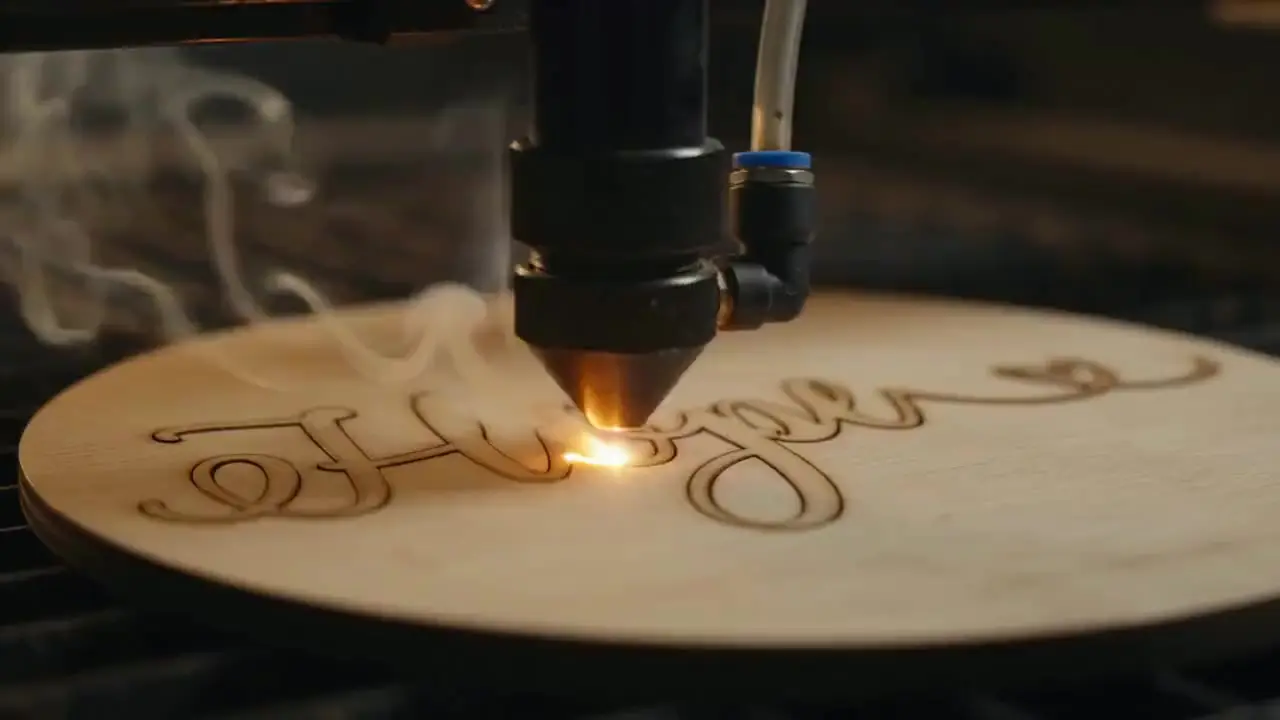
There's a moment in the finishing process where the piece starts to feel like itself. It comes after the laser has run, after the first pass of 120-grit, somewhere in the passes of 220 and 320. The grain opens. The edges round just enough. The wood stops being a material and starts being an object. We can't rush that moment. Every piece we make from raw wood has been through every round of hand-sanding because that's what it takes for the feel to be right.
Mass-produced signs skip this because it doesn't scale. Each sanding pass adds real time. A precision CO2 laser cutter at the settings we use, 1.5mm depth and a slow pass for clean edges, takes longer than a high-speed batch cut. None of this is cost-efficient. The inefficiency is where the craft lives.
We work from a studio in Denver, Colorado. We select each board individually for grain direction and defect placement. We run test cuts on scrap material before we engrave your piece. We hand-sand every face, edge, and back, not just the front. The one exception is the bamboo cutting board: it starts as a factory-finished blank, so we engrave it and re-oil it instead. We apply each finish by hand and let it cure before anything ships. This is not a warehouse operation. Every order comes through us.
Why this costs more than a printed sign
It is a fair question, and the answer is mostly about where the lettering lives. A printed or vinyl sign puts the name on top of the wood. It looks close enough in a photo, and it ages the way anything sitting on a surface ages: the edges lift, the ink flattens in sunlight, and a thumbnail catches a corner one day. On an engraved piece, ours is cut down into the board rather than sitting on top of it. There is nothing on top to peel, because the name is a shape in the wood rather than a layer over it. Run your thumb across one and you can feel where the letters are.
The rest of the difference is the board and what goes on it. Most of what we make is Baltic birch, stained where a piece calls for a darker ground. On our oiled signs the oil soaks in and cures inside the grain instead of drying into a film across it, so there is no coating to chip off the corner it gets knocked on. A few pieces differ: the cutting board is bamboo, the rolling pin and the name puzzle are solid wood, and the drop board and the closet dividers get a satin lacquer that wipes clean. Each product page names its own wood and finish. None of this shows up in a listing photo. It shows up in year six, which is the part of the purchase we can actually do something about. The hardness, density, and finish figures are published if you want to check the claim rather than take it.
The one we got wrong
The worst thing we ever shipped looked fine. It was the first Prize Drop Board, and the coin didn't fall right. It stalled halfway down, then went where it shouldn't. The cuts were clean and the math underneath them was wrong.
So we redid the math and cut it again. And again. It took at least ten versions to find the spacing and the clearance that let a coin fall all the way down every time. That is where the test cuts on scrap wood came from, and the proof we send before anything goes to the laser. A board that didn't work is why both of those exist.
What this means for your order
When you order a personalized piece, we set up your file and send a free proof within 24 hours. We'll set up your name or personalization in design software, proof the spacing, and send you the layout before anything gets cut, so you can see exactly what it will look like on your wall. If the kerning looks off or the font isn't reading right, we adjust. Nothing runs until it looks right.
Once you approve the proof, we cut or engrave, finish, and pack your piece. How long that takes depends on what you ordered. A name sign moves faster than a game board, so each product page lists its own ship window. Whatever it is, the piece leaves here packed with enough protection that the wood arrives exactly as it left the studio. We track every shipment and follow up if anything looks wrong in transit.
If your piece arrives damaged, defective, or not what you ordered, we'll make it right. We remake it free or refund you in full. You never pay return shipping. The 30-day guarantee exists because we stand behind the quality.
When something goes sideways
A board was going to Las Vegas. It was ordered a month early, which was smart, and it shipped to a hotel, which turned out to be the hard part. Somewhere in the last leg the package left the route we could see and stopped moving inside a USPS facility.
So we started calling. Then chatting. Then calling again, until someone could tell us which building it was sitting in. It got there. What we learned is that a hotel usually has one carrier it works with, and that one worked with FedEx. The package should have gone FedEx from the start. Now we ask before a piece ships to a hotel or a venue.
We're glad you're here. If you have a question before you order, send us a message, and we answer personally. If you'd rather read than ask, meet the maker or follow along in the journal.